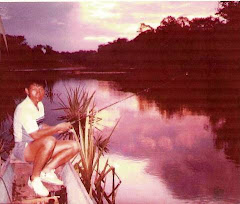
Everything happened so fast. Only a couple of months ago, when I last met him, he was very healthy and was going about his job (he was doing minor house repairs and renovations) as usual.
A month ago he complained of being drained out after the day's job - something he had never felt before. The family suspected something was wrong when his skin began to turn yellow. They sent him to Lumut Naval Hospital but surprisingly it lacked the expertise and he was referred to General Hospital Selayang in Kuala Lumpur which diagnosed him for a 3rd degree cancer of the spleen.
He was given a 0% chance of recovery and after a week there he was sent home where he was cared for by his children. After a week, he seemed to react favourably to the medicine the Hospital gave him. His swollen legs had subsided and the yellow colour in his eyes had gone. He even could mumble some words and talk to his children.
Upon a friend's advice, the children took him to an Islamic faith healer. It was upon his return that his condition took a turn for the worse. He was still very much with the Army - in his mind and spirit. Just before he drew his last breath, he told his children to call for me so that I could bring him to the hospital. "Quickly" he whispered, "there are many soldiers waiting for me." He drew his last breath peacefully at 13.30 p.m on 21 April 2011.
Dear God, how he must had cherished the days and friendships when we were serving in 3rd Malaysian Rangers. Like me, and many of us, our short yet unforgetable lives in 3rd Rangers in the 70s were something that we will cherish till our dying days. Allahyarham SSjn (Rtd) Mohammad Rahmat (Mat Bond) had shown us. God bless his soul. Al-Fatihah.
Thursday, 21 April 2011


Sunday, 10 April 2011
Forming the Association of Bravery Awards Recipients.
The affairs of the recipients of the Malaysian and the British bravery awards had, largely, in the past, been left on their own. Only the recipients of Malaysia's highest bravery award - Seri Pahlawan Gagah Perkasa (SP), an equivalent of the Victoria Cross was given a monthly allowance of RM200.00. The Pingat Panglima Gagah Berani (PGB), an equivalent of the British's Military Cross (MC) was not given any. The promise of payment remained a promise for some 10 years. The Chiefs of the Army came and went and it looked like the promise had been forgotten. In 1998, 6 years after I had retired, I wrote to the Defence Minister, Dato' Seri Mohd Najib Abdul Razak (now the Prime Minister). I appealed to him to give the PGB holders the much-awaited-for allowance that had been promised to us. To my pleasant surprise, he answered my querry almost immediately with an assurance that he would table the motion to Parliament at the next coming sitting. A year later the PGB holders were given a monthly payment of RM300 while the SP holders were paid RM400 - an amount far beyond my expectation!!! And not only that; we were paid the backdated from 1976. I received a whopping RM65,000.00 which made me feel like an instant millionaire. In reality, that amount lasted only a few months. Where did it go to? I don't know. Then sometime in 2007, another recipient took the initiative and wrote to Dato Seri Najib for an increment to RM1000.00. Two years later, the caring government of Malaysia paid the recipients of SP and PGB RM2000.00 and RM1500.00 respectively. Again it was beyond our expectation. Not only that, the recipients of the British's George Cross, Military Cross and George Medal were also eligible for the monetary rewards. Thank you the government of Malaysia!!! The Government of Malaysia, the Armed Forces and the Army didn't forget us. We get invited to attend / witness the yearly Independence Day parades, Armed Forces and Army Day parades. So, really, we are quite busy! The recipients of bravery awards from the Army and the Police had met frequently at these occasions. We have had a number of informal discussions as well as formal meetings to find out the possibility of forming an Association of the SP & PGB. A Task Force was formed to look into the matter and to carry out the necessary works to register the Association with the Registrar of Society (ROS). I was made the interim Chairman of the Association. We had a final meeting on 9 April 2011 to finalise the many documents that are required to be submitted to ROS.

L to R: Kol Roslan PGB, Major (Rtd) Sameon PGB, Me (Interim Chairman), Major (Rtd) Hanafiah PGB (Interim Secretary), Sub-Inspector (Rtd)Mashkor PGB and Major Dato' (Rtd) Sallehuddin PGB.
The Ex-Service Association office at Jalan Bellamy which we had used on a number of occasions was unfortunately closed that day and we had to use the restaurant next to it.

Monday, 28 February 2011
Realising my book on the Iban Trackers and Sarawak Rangers
Writing and documenting the history of the famous Iban Trackers and Sarawak Rangers is closer to becoming my reality. About a year ago I had planned to make my researches in the archives in the UK. However, due to the H1N1 epedemic, the hugh cost and non-availability of good Samaritans / sponsors, the plan had been shelved. But my dream of writing the book lives on. My interest in the affairs of these elite warriors keeps me going in the direction I intended to move. What had happened in the last few months had definitely helped me in making a firm decision to go to Sarawak to meet and interview the remaining 60 of them still alive today. I must see them before they disappear completely from the face of this Earth. Looking at their ages, time is not on my side. Even now, a few of them are fighting for their lives in the government hospitals and two had died in the last few months. A few days ago, another body, Ex British Soldiers Association headed by Che Onn Neamat, has unknowingly joined me in looking after and highlighting the affairs of these elite fighters. I have about 60 names of the surviving members of the Sarawak Rangers living across Sarawak. God-willing I will see and meet all of them. I will be writing to the General Officer Commanding 1st Infantry Division, Major General Awie Subuh, based in Kuching for administrative and logistic supports. I am keeping the month of April 2011 in mind and meantime I am doing the necessary preparations required. Update No. 1 (12 March 2011). On 5 March 2011, in conjunction with the 78th Army Day celeberation in Kuala Lumpur, I met the Deputy Army Chief and the Chief of Staff and confided in them about my plan. They were supportive and had asked me to write to them officially which I did on 9 March 2011. Looking at the number of the ex-soldiers I would like to see and interview, and the locations they are in now, I will most likely spend more than two weeks in Sarawak. As they are stretched right across Sarawak, I will definitely need a 4 x 4 vehicle that the Army may be able to provide me. Accomodations and food in the camps certainly would help lessen my financial burden. I am excited at the opportunity to see and travel right through Sarawak - especially into the interior which are only accessible by long boat. I see plenty of amazing and beautiful sceneries for my camera. Update No. 2 (12 April 2011) I checked with the ADC to the Army's Chief of Staff yesterday as to the status of my letter that I had sent him a few weeks earlier, whereby I had requested for the Army's logistic support in my quest to locate and interview the 60-odd living members of the Iban Trackers and Sarawak Rangers living across Sarawak. I was told the letter is still with the C of S. Except for my concern that time may not be on the side of these gallant fighters. I'm not in a hurry to embark on the journey. A couple of days ago, I received a call from a FINAS (National Film Association) official who is interested to interview me on the Iban Trackers. Apparently, their search in the internet had led them to my blog PGBWARRIOR. Why not? I will contact them when I go to Kuala Lumpur on my next trip in a week or two. I told them about my intended trip to Sarawak and they sounded keen in tagging along. The more the merrier. Some of my schoolmates/classmates in Sarawak might be interested to come along as well.
Tuesday, 25 January 2011
Soldiers of The Sarawak Rangers 1953 - 1963. Part 2. No. 2 Platoon.
Compared to No. 1 platoon which had 43 soldiers, No. 2 platoon had only 30 soldiers. What was the rationale, I don't now. It looked like the strength of the Iban Trackers at the time when it was reformed into Sarawak Rangers (Malayan Unit) in February 1953 was only 73. Why were they not splitted equally in numbers, were equally baffling.
 No. 2 platoon Sarawak Rangers (Malayan Section)


 No. 2 platoon Sarawak Rangers (Malayan Section)


Monday, 3 January 2011
THE SARAWAK RANGERS BAND.
Any mention of the Sarawak Rangers would not be complete without an account of their Filipino band.
There had always been a Rangers’ band of sorts but the standard was not high. Since the second Rajah (Charles Brooke) was very fond of music and the Renee, under the maiden name of Lady de Windt, was recognized as the finest amateur pianist in the whole of France, it was not surprising that in 1888 the Rajah made a special visit to Manila for the sole purpose of engaging a Filipino band.
Going about it in his usual thorough manner, the Rajah auditioned and selected the bandsmen himself. All went well until the bandmaster was enticed away by somebody who offered him better terms. Nevertheless, the band duly arrived in Kuching in May 1888, accompanied by the first bandmaster, Polycarpo. He was succeeded by Reyas, Labarinto, Julian de Vera and, finally Pedro Salosa, who was the bandmaster when the band was disbanded at the same time as the Rangers in 1932, after forty-four years in existence.
Like the remainder of the Sarawak Rangers, the band had rigid but fair conditions of service. Agreement to serve, leave and pensions were all covered, together with rates of pay but these, of course, depended on the period in which the bandsmen served. In 1920 a comprehensive order was produced by the Rajah which covered all of the above points.
The Rajah ruled that the original band should not exceed twelve but would be increased gradually to twenty.
On arrival in Kuching, the bandsmen were ordered to be incorporated into the Military Force, but they were not required to do drill or to keep guard. They had to live in barracks and were under the same discipline as the Rangers. Later, the order was changed and they were expected to know their drill and keep guard when required.
Their first uniform was the same as that of the Rangers except that they wore red caps, with belts and side arms. Later they were given a uniform of their own.
According to the band regulations, the band was required to play for military purposes when needed, practise every morning and play at the Astana and, in addition, as the bandstand two days a week.
The Rajah, the Rangers and the people of Kuching were exceedingly proud of their band, which at that time was considered to be very good indeed but, of course, the standard could not really be compared with that of the present band.
The Rajah took a great personal interest in the band. He insisted that programmes should be carefully selected and if the playing was not up to standard, the bandmaster would receive a stern rebuke. It is recorded that after one public performance, the Rajah called the Commandant, told him that the band was getting worse and worse, that he could not stand it any longer and that, as the bandmaster de Vera seemed to be getting too old, to retire him the next day with a pension of $6 per month.
The band, after a time, did not remain wholly Filipino, since drummers and buglers were often recruited locally and in 1807 the Rajah enlarged the band by engaging seven bandsmen from Perak, West Malaysia. They had formerly been in the Malay States Guides,
The public band performances used to be given two evenings a week and the Rajah again, in his usual thorough manner, ruled that should it rain, the performance would be given the following day. They were given at a bandstand in what was then known as the Esplanade (now called Central Padang). It was then an ornamental garden. These band days used to be greatly enjoyed by the old Rajah but were not entirely popular with others. It was said that, as he grew older, the Rajah became more deaf and sometime hardly knew what music was being played. He used to like to surround himself with the prettiest ladies of all communities and, once the band had started, nobody dared to whisper a word without receiving his icy stare.
For his government officers, attendance at the band was a “must” since, in those days, there was no such thing as annual increment in salaries and the Rajah only gave his officers a rise when he remembered them. So, unless he saw them, he forgot all about them. In other words, no band attendance, no rise in salary.
The crowning glory of the Filipino band came in 1922, when the Borneo-Malaya Exhibition, attended by the Prince of Wales, was held in Singapore. In competition with the Army and Police bands throughout Singapore and Malaya, they gained the second prize – second only to a British Army band. It was a silver medal, three inches in diameter, bearing the head of the Prince of Wales on one side and suitably inscribed on the other. This medal was always displayed in the office of the Commandant, Sarawak Rangers, and after the Rangers had been disbanded, in the office of the Commissioner of Constabulary until the Japanese occupation when, like so many other things, it disappeared.
The Filipino band was disbanded for reasons of economy, together with the Rangers, during the disastrous trade slump of 1932. Several of its members returned to their native land but some remained and joined the newly formed Sarawak Constabulary and helped to form the nucleus of a part-time band under the direction of the last bandmaster, Pedro Salosa’s son Gregory, who had become an Inspector in the Sarawak Constabulary. They carried on until the war broke out with Japan in December 1941.
When the Sarawak Rangers were reformed in 1953 it would appear that only a token effort was made to reform the band. In any case, it seemed that the only effort made did not take place until 1962 when three persons were sent to the Queens Own Highlanders (in either Singapore or Malaya) for Pipe and Drums training. The Pipes and Drums did not materialize because of the Brunei Revolt of 8 December 1962. One of the three persons involved was Warrant-Officer Class II Gasar, who later left the service and joined the Border Scout.
On 15 September 1963, a day before the formation of Malaysia, Sarawak Rangers which had became a part of the British Army, was disbanded. On 16 September 1963, it became the 1st Battalion The Malaysian Rangers. All, except for 100 who chose to remain and form the nucleus of the new unit, returned to their long houses in Sarawak.
Sunday, 19 December 2010
Soldiers of the Sarawak Rangers (1953 - 1963). Part 1.No. 1 Platoon.
Following the successes of the para-military Iban Trackers in the insurgency war in Malaya from 1948 till 1952, it was felt there was a need to reform them into a full-pledge military unit So at the end of 1952, they were reorganised into two experimental platoons. In March 1953, they officially became the Sarawak Rangers, which like all other military units was subjected to the Military Laws. They didn't disappoint. Almost immediately, in their first operation, they made their first contact with the CTs and had their first success. All these while I had been talking about the faceless Sarawak Rangers. We had heard of their exploits, the many bravery awards they had been bestowed with. Twenty one of them were killed during the 12 years of fighting from 1948 to 1960. Amazingly small numbers, bearing in mind that they were at the front most of any operations. They were just names only. Here I'm trying to give them the faces but sadly, most are nameless. There are no records available in Malaysia that I could use to identify each and everyone of them. I am hoping for the surviving members to help me identify their comrades.
NO. 1 PLATOON
THE SARAWAK RANGERS 1953

 |
| Rgr Sengalang ak Uyang |
 |
| 9001145 LCpl Makam Barieng |


 | ||||
| Kpl Adrian ak Tandang |
 |
| Rgr Kriding |
 |
| Cpl Anyau |

 |
| Rgr Salleh |
 |
| LCpl Nyanau |
 |
| Rgr Sridu |
 |
| LCpl Bujang |
 |
| Rgr Bejong |
 |
| Rgr Yangka |

 |
| Rgr Yuni |
 |
| Rgr Klipan |

( TO BE CONTINUED WITH NO. 2 PLATOON)
Subscribe to:
Posts (Atom)

 Posts